
Where damp conditions exist within a property, wood becomes vulnerable to damage from a variety of sources. As a building material, it is durable, hardy and long lasting, as long as it is kept dry.
When excess moisture – howsoever caused – enters and becomes trapped within the domestic environment, and temperatures reach a certain point, optimum conditions are created for the process of decay to begin as a result of wood rot and/or infestation by insects.
Wood Rot
Wood that has reached a moisture content of 20% is vulnerable to attack by wood rotting fungi. These organisms feed by breaking down the walls of wood cells, gradually weakening its structural integrity.
Tell Tale signs:
- Wood discoloration that can be darker or lighter than usual
- Musty “mushroom” smell
- Loss of strength/softening of wood – if decay is advanced, wood will splinter and/or disintegrate
- Wood sounds hollow
- Presence of certain insect species that can only feed on decayed wood
- Evidence of strand or “mycelium” growth
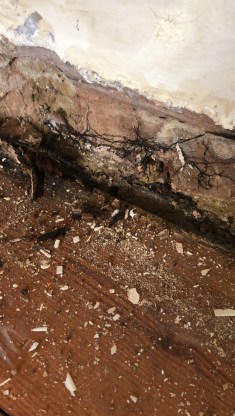
- Evidence of spores &/or fruiting bodies
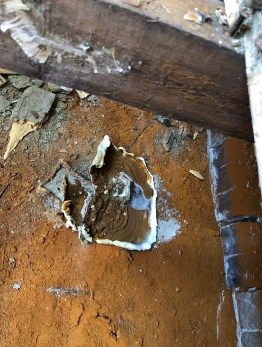
Serpula Lacrymans (dry rot) orange dust-like spores with mature fruiting body (left) and sheets of cotton wool-like mycelium (right) in sub-floor area
Other fungi can be found in buildings that do not cause wood rot, such as plaster fungi, or even moulds – including slime moulds. While happy to take up residence and thrive on wood, these fungi types will not cause it to rot.

Serpula Lacrymans (dry rot) orange dust-like spores with mature fruiting body (left) and sheets of cotton wool-like mycelium (right) in sub-floor area
Wet Rot
There are a number of different wood rotting fungi that fall within the classification of wet rot, which can affect both soft and hard woods. Brown rot turns wood a dark colour and causes “cuboidal” cracking (both across and along its grain). White rot bleaches wood, gives it a fibrous texture and can also be distinguished from brown rot by the lack of cuboidal cracking.
Serpula Lacrymans, which despite being a type of brown rot, is referred to as “dry rot” and so is be treated differently – see the section on Wet Rot for more information.
If you suspect that your home might be suffering wet rot damage, contact us today to arrange an appointment for an investigative survey as the first step towards restoring dryness and watertightness to your home.
Dry Rot
Although dry rot is a type of brown rot, Serpula Lacrymans is not as common as wet rot. It can cause extensive damage, affecting mainly softwoods with deep cuboidal cracking along with the darkening of wood characteristic of all brown rot.
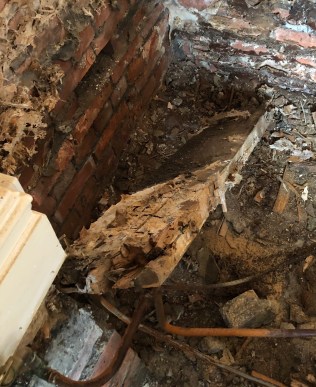
Dry rot is, in some respects, something of a misnomer because as with all types of wood rot, a moisture source is required for it to attack. Serpula Lacrymans spores exist in the environment but if conditions are just right (it is sensitive to drying along with elevated temperature and so doesn’t like it when temperatures exceed 25ºC) dry rot can take hold.
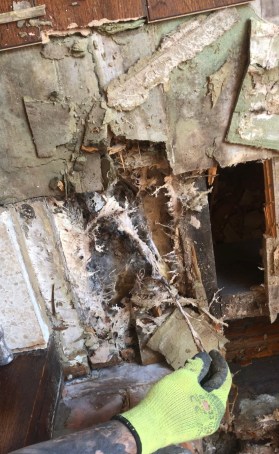
A classic spot for dry rot to establish itself is in wood that’s in contact with wet brickwork. While dry rot initially occurs in areas that have become wet, once established, Serpula Lacrymans is capable of conducting moisture along its strands and head of itself. It does so in order to search for other areas where conditions are wet so it can continue to feed and grow. While dry rot cannot feed on masonry, it is capable of growing through it in search of new food sources.
If you suspect that your home might be suffering dry rot damage, contact us today to arrange an appointment for an investigative survey as the first step towards restoring your home.
Insect Infestation
Certain insect species use wood as a food source at various points in their life cycle. In the UK, the majority of these woodboring insects are from the beetle family. Living trees can host any number of beetle infestations, but problems can arise if the host turns out to be the floorboards, structural or decorative timbers and beams, woodwork, or even the furniture within our homes.
The type of woodboring beetle most often encountered in the UK is the Common Furniture Beetle (Anobium punctatum). It favours softwoods along with European hardwoods and tends to feed off the outer layer of recently formed wood, known as the ‘sapwood’, rather than the inner ‘heartwood’.
The far less common but more sinisterly-named Deathwatch Beetle (Xestobium rufovillosum) prefers the sapwood and heartwood of partially decayed hardwoods like Oak. It tends to be found in older buildings, where ‘green’ hardwoods that had not been given sufficient time to dry out were used extensively in the construction process.
Woodboring insects are often referred to collectively as ‘woodworm’ and to understand why, we need to consider their life cycle. An adult female will typically lay eggs in the tiny cracks and crevices on and just below the wood’s surface, although in the case of the Deathwatch Beetle, that isn’t necessarily the case. Once the eggs have hatched, the larvae burrow down into the sapwood where they will spend the greatest proportion of the insects’ total life cycle feeding.
It is during this larval – ie woodworm – period of the woodboring insects’ life cycle that the greatest potential structural damage will take place. And just how long the larval phase lasts depends on the species of woodboring insect, as well as the environmental conditions. The Common Furniture Beetle, for example, can spend more than 3 years feeding off seasoned sapwood before it matures and becomes a pupa, while the Deathwatch Beetle larvae might take up to 14 years to reach the pupa stage.


In both cases, the pupa stage lasts only a matter of weeks before the adult beetle burrows its way up and emerges from the wood, leaving a distinctive ‘flight hole’ as the evidence of its path. Adult males live for only a few days with females living for up to a few weeks; time enough to lay fresh eggs after they have mated, so that the cycle can repeat itself. Again, adult woodboring insect species will emerge and be visible at different times of the year: some as early as March and some as late as October. Deathwatch Beetles need higher temperatures to fly, but it has been shown that this species may not actually emerge and can mate within established cavities within the wood, before the adult females are capable of burrowing even deeper into timbers to lay fresh eggs.
Tell Tale Signs:
- Holes in the wood’s surface, which are the flight holes created by the emerging adult beetle. Clean circular edges that differ in size and shape depending on insect species
- Bore dust, or ‘frass’, which is the waste produced by feeding larvae, and can be seen in piles close to holes
- Presence of larvae when wood is probed
- Presence of tunnels, again, through probing, or possibly exposed through wear
- Irregularities in the wood’s surface
It is important to bear in mind that while the above signs are indicators of a woodworm infestation, they do not necessarily establish an active attack. For example, flight holes might already have been present in wood cut from trees that were subject to insect infestation while alive. Or, in the case of older buildings, flight holes might have appeared hundreds of years ago, because unseasoned oak hardwood that was already under fungal attack after the tree was felled, was used in the original construction. It is also possible that old frass could have been shaken from wood from the vibration of human footfall.
If you suspect that your home might be suffering damage from active insect attack, contact us today to arrange an appointment for an investigative survey to establish whether timber preservative treatment is required.